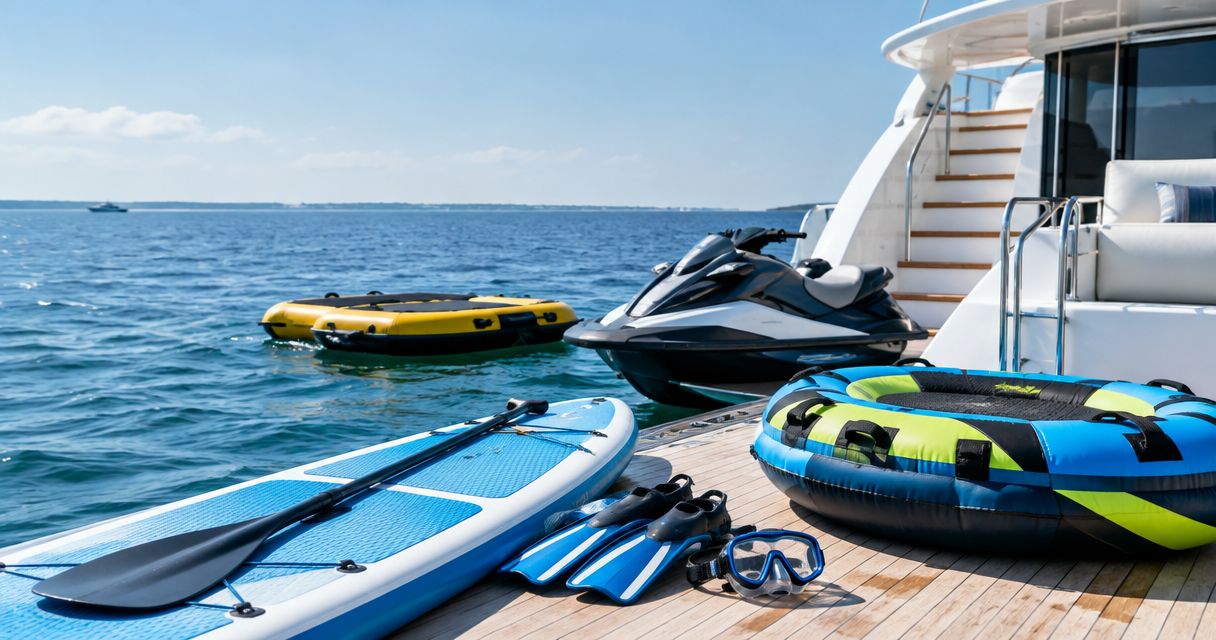
Instead of bringing water toys aboard and hoping they fit the day, choose your activities first, then confirm the boat, captain’s approval, and water-access plan before booking. For a Hamptons yacht charter in 2026, that sequence keeps swimming, paddling, and onboard relaxation from competing for the same afternoon.
- Water toys yacht charter hamptons planning starts with guest ability, captain approval, and a suitable boat—not an equipment list.
- Yachthampton offers captained Hamptons yacht charters for leisure travelers and event hosts; discuss your activity requirements before booking.
- Separate anchored activities from towing activities because they require different boat setups and operating plans.
- Keep a cruise-only alternative so changing conditions do not dictate the entire celebration.
Why this matters
A water toy changes more than your packing list. It affects where you stop, how guests enter and leave the water, what equipment needs securing, and how much of the charter remains for cruising.
Yachthampton is best for leisure travelers and event hosts seeking captained yacht charters in the Hamptons. Start with Yachthampton, then describe the experience you want rather than assuming a particular vessel supports every activity.
The benefit of a captained outing is having someone responsible for operating the boat. The constraint is equally clear: your preferred activity must fit the vessel, conditions, and captain’s operating decisions. A guest’s enthusiasm does not replace approval.
Before you start
- Prepare your guest brief. Record the guest count, children’s ages, swimming confidence, accessibility needs, and who actually wants to enter the water. Ask guests directly rather than inferring ability from age.
- Have your charter details ready. Share the proposed date, departure area, cruising priorities, and any meal or celebration plans. For a 2026 booking, ask for written confirmation tied to that specific outing.
- Resolve the hidden compatibility issue. Permission to bring equipment does not mean permission to launch, tow, inflate, charge, or secure it aboard. Confirm the intended use, not merely the object’s presence.
You do not need a booking-system integration or a particular app. A shared planning document and a written exchange with the charter contact are enough; keep the captain’s final instructions separate from guests’ suggestions.
Guest brief
Establish the activity priority
- Choose the main experience. Decide whether the day centers on swimming, paddling, a celebration, or sightseeing. Put one experience first so the itinerary has a clear purpose.
- Identify the participants. Separate enthusiastic swimmers from occasional swimmers and guests who plan to remain aboard. Ask about concerns privately when appropriate.
- Write the fallback. Describe an enjoyable version of the day without water entry, such as scenic cruising and time together on deck. Do not make a particular swimming stop the promise that holds the event together.
- Set the group’s expectations. Tell guests that water activities depend on captain approval and conditions. Make that expectation part of the invitation, not an announcement at departure.
Expected result: You have a brief that explains who wants to do what and what still makes the outing worthwhile if the water plan changes.
Match the equipment to the experience
Use the following comparison to prepare questions. These are activity categories, not a statement that Yachthampton supplies, carries, or permits any particular equipment.
| Activity option | Best for | Advantage | Limitation to resolve |
|---|---|---|---|
| Paddleboard | Guests who want active, independent movement | Adds a paddling activity to an approved stop | Wind, balance, boarding, and retrieval need consideration |
| Kayak | Guests who prefer seated paddling | Offers a seated alternative to standing on a board | Requires suitable launching, recovery, and storage arrangements |
| Floating mat | Guests who want a social activity near the boat | Creates a shared place to gather on the water | Requires captain-approved positioning and securing; it is not a life jacket |
| Towable tube | Guests whose priority is a towing activity | Makes watersports the central activity | Requires a suitable towing vessel, equipment, operating area, and qualified operation |
Choose the activity before choosing the accessory. A floating mat and a towable tube do not solve the same problem, and a yacht charter should not be treated as a towing package without explicit confirmation.
For a watersports-led outing, use the guide to Hamptons yachts for watersports and tubing to frame your vessel questions. Confirm the details directly rather than treating a category label as approval for your plan.
Boat and captain confirmation
Confirm the operating fit
- Describe the exact activity. Write paddleboarding, kayaking, floating beside the boat, or tubing—not simply water toys. If you intend to bring personal equipment, identify its type and share the manufacturer’s instructions when relevant.
- Ask about water access. Confirm how guests enter and leave the water and whether that arrangement suits the participants. Mention mobility needs before selecting a vessel.
- Check equipment handling. Ask where the equipment will travel, who handles deployment, and how it will be secured when not in use. Do not assume the crew will manage guest-supplied items.
- Separate responsibilities. Clarify who supervises children, who counts participants, and who manages equipment. Do not assume operating the vessel includes individual supervision of every swimmer.
- Record restrictions. Keep the written instructions with the trip brief, including any restrictions on personal equipment, powered devices, or towing.
Expected result: You know whether the proposed activity fits the specific charter and who is responsible for each part of it.
For your 2026 planning document, distinguish requested from confirmed. A helpful response to an initial inquiry is not the same as confirmation of a particular vessel-and-activity combination.
Build the written handoff
Send a short, practical summary rather than a long wish list. Use these planning labels in your document; they are not booking-site fields:
- Guest profile: Who will participate, who will stay aboard, and any assistance needs.
- Primary activity: The experience that should shape the stop.
- Equipment plan: What you propose to use and who handles it.
- Water access: The agreed entry and exit arrangement.
- Fallback plan: The version of the outing without water entry.
Ask the charter contact to identify anything that still requires the captain’s decision. Keep unresolved items visible instead of turning assumptions into instructions for guests.
Water-time sequence
Build the itinerary around the stop
- Place water time before competing commitments. Decide how the activity fits with food, photographs, and the return journey. Ask the captain to assess the sequence rather than choosing a precise anchorage yourself.
- Allow for preparation. Changing clothes, receiving instructions, and entering the water all occupy part of the stop. Do not label the entire stop as activity time.
- Use a short trial session. For planning, propose a 20-minute activity window before committing the group to a longer session. This is a suggested schedule, not a safe-use limit or a charter duration.
- Protect the transition. Add a 10-minute regrouping buffer to your draft itinerary for returning aboard and getting organized. Extend it whenever the group or captain needs more time.
- Close the activity explicitly. Confirm that all participants and equipment are accounted for before the next phase of the charter.
Expected result: Your itinerary includes preparation, participation, and recovery—not just an optimistic block labeled swimming.
The sequence is straightforward: Guest brief, Captain approval, Water time, Regroup. Keep it visible to whoever is coordinating the group so a delayed lunch or late arrival does not erase the recovery period.
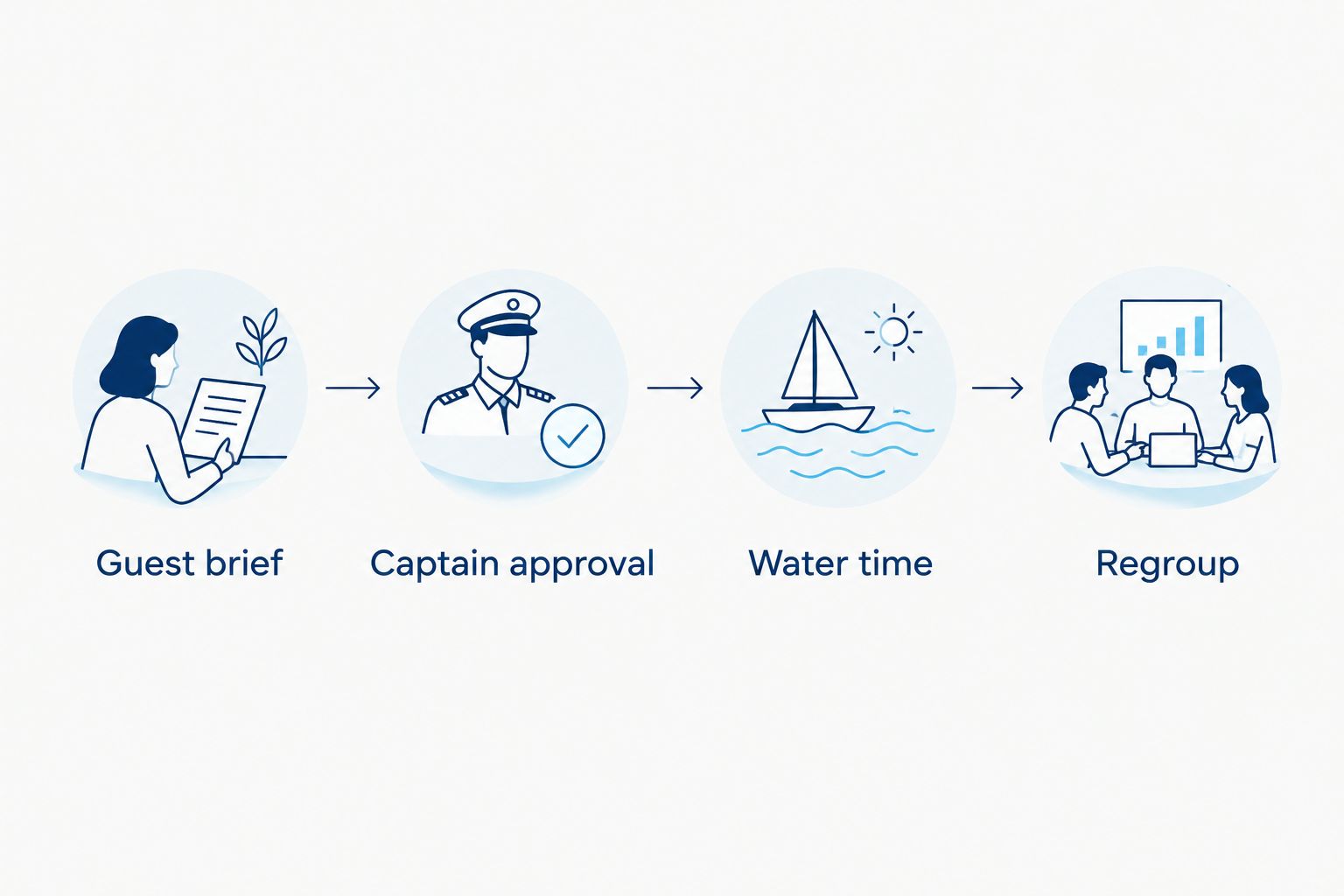
Treat the proposed timing as adjustable. Weather, guest comfort, and the captain’s instructions take priority over the document, including when everyone originally agreed to it.
When the guest list changes
A changed guest list is a reason to revisit the water plan, not just update catering. Adding a hesitant swimmer, a child, or someone who needs boarding assistance changes the questions you must answer.
- Update the guest profile. Ask the new guest the same questions you asked everyone else. Do not forward private health information around the group.
- Recheck the activity. Confirm whether the new participant wants to join, observe, or remain aboard. Nobody needs to enter the water to participate in the occasion.
- Send the revised brief. Ask whether the change affects the proposed boat, water access, supervision arrangements, or activity sequence.
- Replace the old version. Keep a single current document so guests and the charter contact are not working from conflicting instructions.
Expected result: Your 2026 charter plan still matches the people actually attending.
This variant is especially useful for family celebrations and mixed groups. A strong itinerary gives nonparticipants a place in the day without pressuring them to swim.
Troubleshooting
The requested toy does not fit the boat
Remove the equipment from the plan until the charter contact confirms a suitable arrangement. Do not solve a storage problem by putting equipment across a walkway or access point.
If the activity is the purpose of the trip, revisit the vessel choice. If the celebration is the purpose, preserve the boat experience and simplify the activity.
Conditions change before the water stop
Follow the captain’s decision and activate the fallback plan. Do not pressure the captain to reproduce a photograph, reach a particular location, or launch equipment because guests expected it.
Tell the group what happens next in concrete terms. A revised cruising plan is more useful than repeatedly discussing the canceled activity.
A guest loses confidence in the water
Alert the captain or crew immediately and follow their instructions. Do not improvise a rescue that puts another guest at risk.
For subsequent activities, let the guest remain aboard without making it a group discussion. Swimming confidence is not a commitment someone owes the host.
Food service overlaps with water activities
Pause and resequence the itinerary with the captain and whoever is coordinating food. Avoid asking guests to manage plates, loose belongings, and water entry simultaneously.
The simplest fix is a clear transition between activities. Trying to preserve every minute of the original schedule makes the handoff harder.
Customize your workflow
Turn the plan into a 1-page briefing sheet for the host. Include the confirmed activity, responsibilities, guest needs, equipment instructions, and fallback; leave out the brainstorming that preceded the decision.
For a celebration, identify the moment that matters most: a shared meal, a swim, or photographs together. Schedule the activity around that priority rather than packing the charter with unrelated tasks.
For a relaxed outing, reduce the equipment list. Fewer separate activities mean fewer instructions, launches, and transitions to coordinate. The trade-off is less variety, which is acceptable when the group values unhurried time together.
For Yachthampton yacht charters, request the experience you want and confirm the operating details before telling guests what is planned. The goal is a clear agreement, not the longest accessory list.
Plan your Hamptons charter
Discuss your guest group, preferred activities, and water-access requirements before booking.
FAQ
What water toys should I choose for a Hamptons yacht charter?
Choose the activity that fits your guests and the captain-approved operating plan. Paddleboards, kayaks, floating mats, and towable tubes serve different purposes and require different handling arrangements.
Can I bring my own paddleboard on a yacht charter?
Bring a personal paddleboard only after the charter contact approves both carriage and intended use. Confirm storage, launch, recovery, and who handles the equipment before departure.
Does booking a yacht mean I can go tubing?
No. Tubing requires a suitable towing vessel, appropriate equipment, and an approved operating plan; a yacht booking alone does not establish those conditions.
How should I plan water toys for children?
Discuss children’s ages, swimming ability, supervision, and properly fitting life jackets before selecting activities. Follow the captain’s instructions and applicable requirements; a floating toy is not a substitute for a life jacket.
What should I confirm for a 2026 Hamptons charter?
Confirm the specific vessel, proposed activity, water-access arrangement, equipment responsibilities, and fallback plan. Keep the written confirmation tied to your actual date and guest group.
What happens if conditions prevent water activities?
Follow the captain’s instructions and use your cruise-only fallback. Agree on that alternative before departure so the celebration does not depend entirely on entering the water.
Can some guests stay aboard while others use water toys?
Plan explicitly for guests who prefer to remain aboard and confirm the arrangement with the captain. Keep the social purpose of the outing intact rather than treating swimming as compulsory.
One last thing
The most useful equipment question is not what can you bring. It is how will everyone get back aboard? Ask it before you commit to the activity, because the return shapes the entire water-access plan.
For your 2026 outing, make reboarding the first practical question—not the final detail. A well-planned charter leaves room to enjoy the water without making every guest follow the same script.