
Instead of coordinating menus, dock deliveries, and guest requests in separate messages, add Hamptons yacht charter catering through one written brief tied to your booking. Confirm the vessel’s food arrangements, delivery access, and service responsibilities before you commit to a caterer for your 2026 outing.
- For Yachthampton bookings, request Hamptons yacht charter catering approval before committing to a menu or delivery.
- Match your catering plan to confirmed storage, serving space, dock access, and cleanup arrangements.
- Assign one organizer to manage dietary requests, caterer communication, and booking changes.
- Keep the approved menu and delivery instructions attached to the same charter brief.
Why this matters
A yacht catering plan has to work at the dock and on the water. A beautiful menu is not enough if nobody has confirmed who receives the food, where it stays chilled, or who serves it.
Yachthampton is best for hosts seeking a captained Hamptons charter, not a catering-only booking. Start with the Yachthampton charter conversation, then ask which food arrangements are permitted for your specific vessel and trip.
Treat catering as a separate approval within your 2026 charter plan. A charter confirmation does not establish that a particular menu, outside vendor, onboard preparation method, or service team has been accepted.
Before you start
- Gather your booking details. Have the charter date, departure location, guest count, vessel details, and booking reference if one has been issued. For an unconfirmed trip, describe the outing you want without presenting tentative details as final.
- Assign 1 organizer and identify 2 operational contacts. Your organizer collects guest requests; the charter contact confirms vessel arrangements; the catering contact manages food preparation and delivery. One business can fill multiple roles, but every responsibility needs an owner.
- Resolve the dock-access gotcha first. Ask where a vendor can deliver, who can receive the order, and whether loading must happen before guests board. A street address alone does not confirm access to the boat.
You do not need a particular app to follow this workflow. A shared document and one email thread are enough; keep decisions in writing rather than spreading approvals across guest messages.
Charter and catering brief
Set the guest and service requirements
- Record the charter essentials. Write the date, departure point, departure time, expected return, guest count, and organizer’s contact details. Mark anything unresolved as tentative.
- Describe the occasion. Say whether you are hosting a birthday, family gathering, anniversary, or client outing. Explain when you want food served in relation to boarding and cruising.
- Collect dietary information privately. Ask guests about food allergies and dietary restrictions. Pass requirements to the caterer accurately, and ask how those requirements will be handled before describing a dish as suitable.
- Choose the intended service format. State whether you want individually packed meals, shared platters, or staffed service. These are requests to assess, not assumed charter inclusions.
- Separate food from other requests. List beverages, ice, serving utensils, tableware, waste removal, and service staff separately. Ask who supplies each item.
Expected result: You have one brief that explains who is attending, what they need, and how you want the meal to work. The charter contact and caterer can assess the same request instead of interpreting different versions.
For a larger celebration, the yacht charters for wedding planners guide provides a related planning topic. Keep your event schedule and catering brief connected so a change to one triggers a review of the other.
Compare service formats before selecting a menu
Choose the format around the experience you want and the vessel arrangements that receive approval. None of these options establishes what a particular Yachthampton charter includes.
| Catering format | Best for | Advantage | Limitation to resolve |
|---|---|---|---|
| Individually packed meals | Hosts prioritizing straightforward distribution | Each guest receives a separate meal | Packaging creates waste, and dietary meals need clear identification |
| Shared platters | Social gatherings with flexible eating times | Guests can choose portions while mingling | Platters need suitable surfaces, serving utensils, and a food-safety plan |
| Staffed service | Hosts who want someone assigned to serving | Service responsibilities can be assigned explicitly | Staff access, space, duties, and vessel permission need confirmation |
Select the service format before approving the dishes. A menu designed for seated dining creates different requirements from food guests can eat while socializing.
For each proposed format, ask what happens between delivery and service. Include cold storage, hot holding where relevant, portioning, and cleanup in that answer—not just the presentation.
Vessel and delivery approval
Confirm the practical requirements
- Ask about food preparation. Establish whether the plan requires food to arrive ready to serve. Do not assume a galley, oven, refrigerator, or preparation area is available for catering use.
- Confirm storage and serving space. Give the charter contact the proposed packaging and serving format. Ask where food can be secured and whether the intended service arrangement fits.
- Agree on the handoff. Request a delivery location, receiving contact, and agreed delivery window. Clarify whether the caterer delivers to a meeting point or is permitted to approach the vessel.
- Define responsibility onboard. Ask who receives, stores, sets out, serves, and clears the food. Do not assign catering duties to the captain or crew without explicit agreement.
- Confirm vendor and staff access. Before arranging staffed service, ask whether catering personnel can board and what requirements apply. Include those personnel in the vessel’s guest-count discussion.
- Resolve waste and equipment removal. Establish who removes packaging, leftovers, reusable trays, and catering equipment, and where the handoff happens after the charter.
Expected result: Both parties have accepted a practical delivery and service plan. There are no unassigned tasks hidden between the caterer’s delivery and your guests’ first meal.
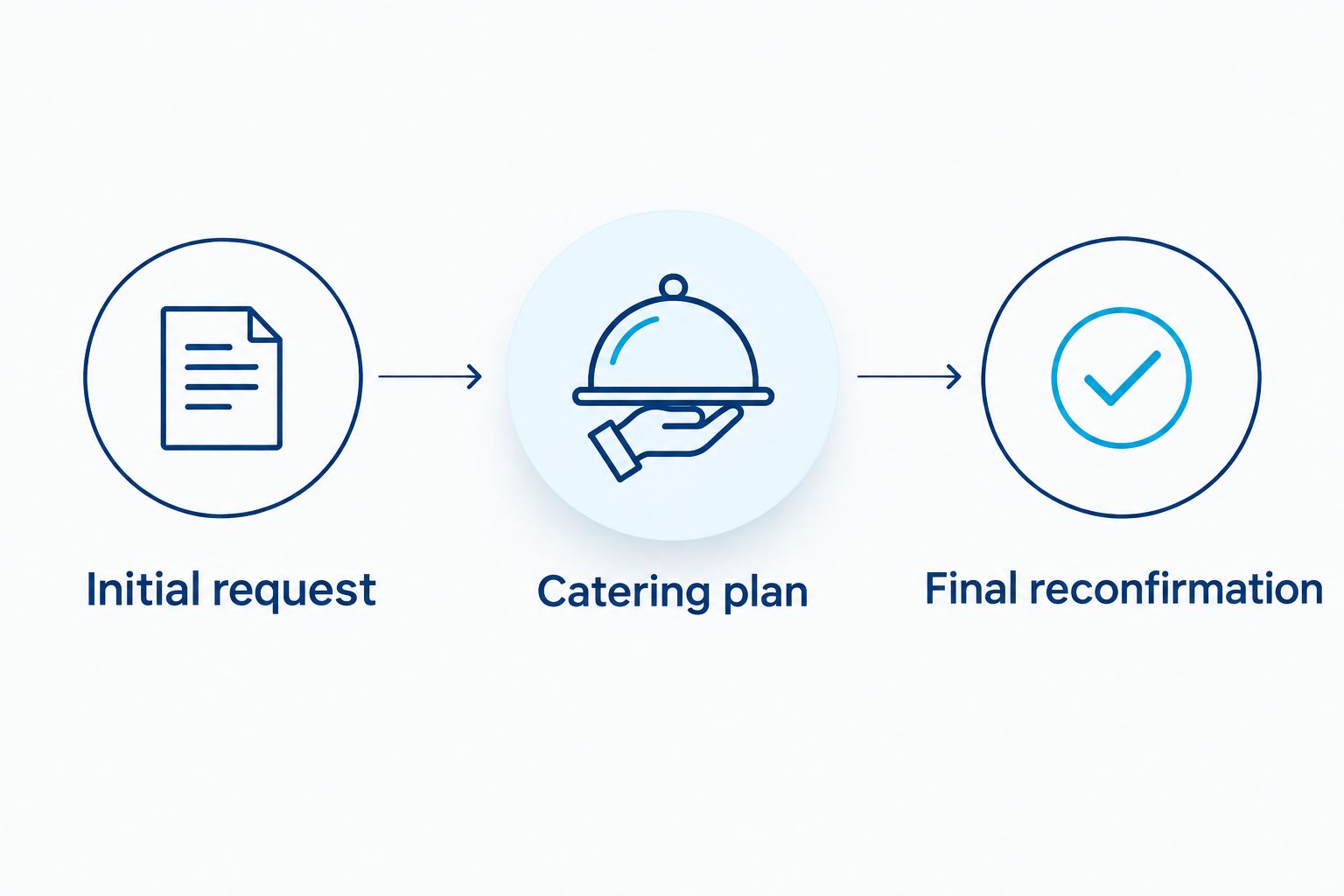
Use 3 approval checkpoints for your 2026 outing: the initial request, the agreed catering plan, and the final reconfirmation. These are planning checkpoints, not a claim about any operator’s required booking process.
Write a clear catering request
Use the following fields in your message. These are suggested brief headings, not labels from a booking interface:
- Booking details: Date, vessel if confirmed, departure location, and charter reference.
- Guest requirements: Current guest count, dietary restrictions, and any food allergies requiring discussion.
- Requested format: Packed meals, shared platters, or staffed service.
- Food timing: When you want guests to eat relative to boarding and the outing.
- Delivery plan: Proposed handoff location, receiving contact, and delivery window for approval.
- Open questions: Vendor permission, storage, service duties, tableware, beverages, and cleanup.
End with a specific request: ask the charter contact to confirm the permitted arrangement and identify anything that must change before you instruct the caterer.
Keep the distinction between requested and approved visible. Sending a detailed message is not the same as receiving acceptance.
Final booking record
Close the loop before departure
- Obtain the caterer’s written menu and service description. Check that it matches the approved format and records the dietary requirements discussed.
- Reconcile the two confirmations. Compare the caterer’s delivery instructions with the charter contact’s instructions. Resolve different locations, times, or receiving contacts immediately.
- Review change and cancellation terms. Check the applicable terms with each provider, including how changes to the charter affect the food order. Do not assume the two arrangements share the same conditions.
- Send one final summary. Include the approved menu, guest count, delivery details, responsibilities, and unresolved questions. Ask each responsible party to acknowledge their part.
- Give guests only the details they need. Share boarding instructions and the agreed meal format. Keep vendor coordination with the organizer rather than inviting separate guest instructions.
Expected result: Your 2026 departure plan contains a single current catering record, with an owner for every task. Guests know what to expect, and vendors are not working from conflicting messages.
Start Your Charter Conversation
Discuss your Hamptons outing and ask which catering arrangements fit your charter.
When your booking changes
The adjacent workflow is just as important: update catering whenever the charter details change. A new guest count, departure point, vessel, or schedule can invalidate an otherwise sound plan.
- Identify the changed detail. Write the old information and its replacement in the same message. Avoid sending only a new attachment without explaining what changed.
- Check the consequences. A guest-count change affects portions and dietary meals; a vessel change requires renewed storage and service approval; a departure change affects delivery.
- Request fresh confirmation. Ask both contacts to accept the revised arrangement under their applicable terms. Do not treat silence as approval.
- Replace the previous summary. Date the current version and tell everyone which earlier instructions it replaces. Send guests updated boarding information when relevant.
Expected result: A change to your charter produces a matching catering update, rather than leaving the caterer attached to an outdated plan.
For a 2026 celebration with several decision-makers, keep one organizer authorized to send final instructions. Other hosts can contribute preferences without creating competing versions.
Troubleshooting
The caterer cannot reach the agreed handoff point
Contact the designated receiving person and confirm a permitted alternative with the charter contact. Do not instruct the driver to enter restricted dock areas or leave food unattended; communicate the revised handoff to both parties.
The menu needs equipment nobody confirmed
Return the menu to the caterer and request a version compatible with the approved preparation and storage arrangements. Change the menu before assuming the boat can supply missing equipment.
Dietary requirements arrive after the menu is agreed
Send the exact requirement to the caterer and ask what accommodation is possible. Obtain confirmation before telling the guest their meal is suitable, particularly when food allergies are involved.
The guest count changes
Update the charter contact and caterer together. Ask them to confirm vessel acceptance, revised portions, and any effects under their terms before inviting additional guests or promising additional meals.
Nobody has accepted cleanup responsibility
Assign clearing, waste handling, and equipment return before departure. If no one accepts a task, simplify the service plan rather than leaving the captain, crew, or guests to discover it onboard.
Customize your workflow
Build the meal around the outing, not the other way around. For a family gathering, prioritize clear meal identification and a serving plan that does not leave the host distributing every item; for an anniversary, coordinate the meal with the part of the outing you want to keep uninterrupted.
For Yachthampton yacht charter catering requests, keep preferences separate from requirements. A presentation style is a preference; an allergy requirement or an approved delivery location needs explicit handling.
Save your brief as a reusable template after the trip. Remove personal dietary information before sharing it with another group, and recheck vessel and vendor arrangements for every new booking.
FAQ
How do I add Hamptons yacht charter catering to my booking?
Send your charter contact a written catering request with the date, guest count, dietary requirements, intended service format, and delivery needs. Confirm permission, onboard arrangements, and responsibilities before committing to the catering order.
Does a Yachthampton charter automatically include catering?
Do not treat catering as included unless your specific booking confirmation states it. Ask Yachthampton to confirm the food arrangements and any separate vendor responsibilities for your charter.
Can I bring my own caterer on a Hamptons yacht charter?
Use an outside caterer only after the charter contact approves the arrangement. Confirm delivery access, food storage, service requirements, and whether catering personnel are permitted onboard.
What is the best catering format for a yacht outing?
The best format is the one that fits the approved vessel arrangements and your intended meal service. Packed meals simplify distribution, shared platters support mingling, and staffed service requires additional coordination.
How should I handle food allergies on a yacht charter?
Give the caterer accurate allergy information and ask how preparation, packaging, and service will address it. Do not promise an allergen-free meal or environment without explicit confirmation from the responsible provider.
What happens to catering if my charter changes?
Notify the charter contact and caterer together, then obtain approval for the revised plan. Each provider’s terms govern its arrangement, so confirm the consequences rather than assuming the food order changes automatically.
What should I reconfirm before my 2026 charter departure?
Reconfirm the guest count, approved menu, dietary arrangements, delivery location, receiving contact, and service responsibilities. Make sure both providers are using the same current summary.
One last thing
The receiving contact is as important as the menu. Before departure, make sure one named person knows that food is arriving, can reach the delivery contact, and has accepted responsibility for the handoff. That small decision closes the gap between a completed order and a meal actually reaching your guests.