Instead of rebuilding your yacht plans for every trip, organize FleetShare membership yacht access around a single annual travel brief, then confirm which membership terms support it. Start with Yachthampton and treat year-round access as a planning goal—not a membership entitlement until the agreement confirms it.
- Plan FleetShare membership yacht access around your actual travel calendar, not an assumed year-round entitlement.
- Yachthampton offers FleetShare memberships, yacht charters, and captained excursions for leisure travelers and event hosts.
- Confirm regional coverage, reservation rules, and guest terms before committing to a membership.
- Keep Hamptons and Palm Beaches plans separate until cross-region membership access is confirmed.
Why this matters
A yacht membership and a year-round boating calendar are different things. Membership describes a relationship with an operator; your calendar requires specific destinations, suitable outings, and agreed booking terms.
Yachthampton is best for leisure travelers and event hosts seeking yacht charters or FleetShare membership in the Hamptons and Palm Beaches. The choice between those services starts with how you intend to use the water—not with the membership label.
For your 2026 plan, separate what you want from what the agreement provides. That distinction keeps a summer celebration, a winter escape, and a recurring leisure outing from becoming one vague request.
Before you start
Prepare these materials before discussing enrollment or organizing recurring trips:
- A 12-month travel outline. Mark when you expect to be in the Hamptons or Palm Beaches, your preferred outing dates, and which plans have room to move.
- Your booking authority and guest brief. Identify who will approve arrangements, who will attend, and any boarding, mobility, or activity requirements that need discussion.
- The current membership agreement and reservation instructions. The non-obvious gotcha: an operator serving both regions does not establish that one membership covers both. Confirm that point explicitly before designing a cross-region calendar.
This is a planning workflow, not a member-portal tutorial. Use the booking channel and account instructions supplied with your agreement; do not assume a particular app, dashboard, or automated reservation system.
Your access requirements
Build the travel brief
- Create a document titled Travel brief. Add your name, the person authorized to approve arrangements, and the purpose of the plan.
- Add a Region column. Keep Hamptons outings separate from Palm Beaches outings so each request has an unmistakable destination.
- Add Preferred date, Alternate date, Guest needs, and Outing purpose columns. These are labels for your own document, not claimed fields in a membership portal.
- Write the experience first: a relaxed family cruise, a celebration, or time on the water with visiting friends. Leave vessel selection for the discussion that follows.
Expected result: You have one brief that explains where you will be, who is joining, and what each outing needs to accomplish.
Keep the brief selective. A calendar filled with speculative trips does not help you assess a membership; a short list of trips you genuinely intend to take does.
For each entry, distinguish a fixed event from a flexible outing. A birthday tied to a particular date deserves a different conversation from an afternoon cruise that fits anywhere within your visit.
Separate preferences from requirements
- Mark each request Essential or Flexible in your document.
- Put accessibility needs, guest requirements, and event timing under Essential where they genuinely determine whether the outing works.
- Put preferred scenery, atmosphere, and optional activities under Flexible unless they are central to the occasion.
- Record who must approve a change before it becomes part of the plan.
Expected result: Your contact can distinguish a preference from a condition that makes or breaks the trip.
Avoid turning preferences into promises to guests. An idea discussed during planning is not a confirmed part of your outing until the written arrangements include it.
Your membership terms
Match the agreement to the calendar
- Request the current FleetShare membership documents for your 2026 planning period.
- Ask which regions, vessels, outing types, and member privileges the proposed agreement covers. Record the answers beside the relevant calendar entries.
- Confirm how reservation requests are submitted, how acceptance is communicated, and what rules govern changes or cancellations.
- Ask how captaining, guest participation, and event use are handled under the proposed arrangement. Treat each as a question, not an assumed inclusion.
- Resolve any difference between a verbal explanation and the written agreement before proceeding.
Expected result: Every intended use has either a documented basis in the agreement or a clearly identified question to resolve.
The useful test is concrete: does the agreement support the trips in your brief? A broad description of membership does not answer whether your particular family outing or hosted event fits its terms.
For 2026, plan from the agreement outward—not from a desired itinerary backward. If your needs fall outside the proposed membership terms, discuss a separate charter rather than treating an exception as part of the membership.
Choose the right planning route
The table below compares planning approaches, not unverified FleetShare benefits. Use it to decide which conversation to have before committing.
| Planning route | Best for | Advantage | Limitation |
|---|---|---|---|
| FleetShare membership review | Travelers considering repeated yacht outings | Gives you a defined agreement to assess against recurring plans | Requires careful review of covered uses and member obligations |
| Individual yacht charter inquiry | A particular celebration or standalone outing | Keeps the inquiry focused on one event and its requirements | Does not establish an ongoing membership relationship |
| Membership review plus separate charter inquiry | Travelers combining recurring leisure with a distinct hosted event | Separates routine plans from event-specific requirements | Requires you to coordinate separate arrangements |
Yachthampton offers both FleetShare memberships and yacht charters. Choose the service that matches the outing; do not stretch a membership assumption to cover an event.
A membership review is less useful when you cannot yet describe your intended use. An individual charter inquiry is more focused for a single occasion, but it does not answer your longer-term access questions.
Your reservation workflow
Create the request record
- Use the reservation channel specified in your membership instructions. Keep the supplied contact details with your travel brief.
- Submit the region, preferred date, alternate date, guest information, and outing purpose together.
- Ask for a written response identifying the agreed arrangements and any remaining decisions.
- Mark the entry Requested in your own calendar. Change it to Confirmed only after receiving explicit confirmation through the agreed channel.
- Copy the confirmed departure details and instructions into the calendar entry without rewriting their meaning.
Expected result: Your calendar distinguishes an idea, a submitted request, and a confirmed outing.
Do not use a calendar invitation as evidence of a reservation. A personal reminder records your intention; confirmation records the arrangement with the operator.
For your 2026 trips, keep the original confirmation alongside the calendar entry. That gives you a clear reference when another guest asks about departure details or when an event organizer proposes a change.
Close the guest-information loop
- Send guests only the confirmed meeting details and instructions relevant to them.
- Collect unresolved guest requirements and send them through the agreed contact channel.
- Ask the operator to confirm any change that affects the arrangements before updating the group.
- Keep one person responsible for communicating the final version.
Expected result: Guests receive one consistent set of instructions, and the operator receives one coordinated set of requests.
A group chat is useful for conversation, but it should not become the booking record. Keep final decisions in the request record so casual suggestions do not become supposed commitments.
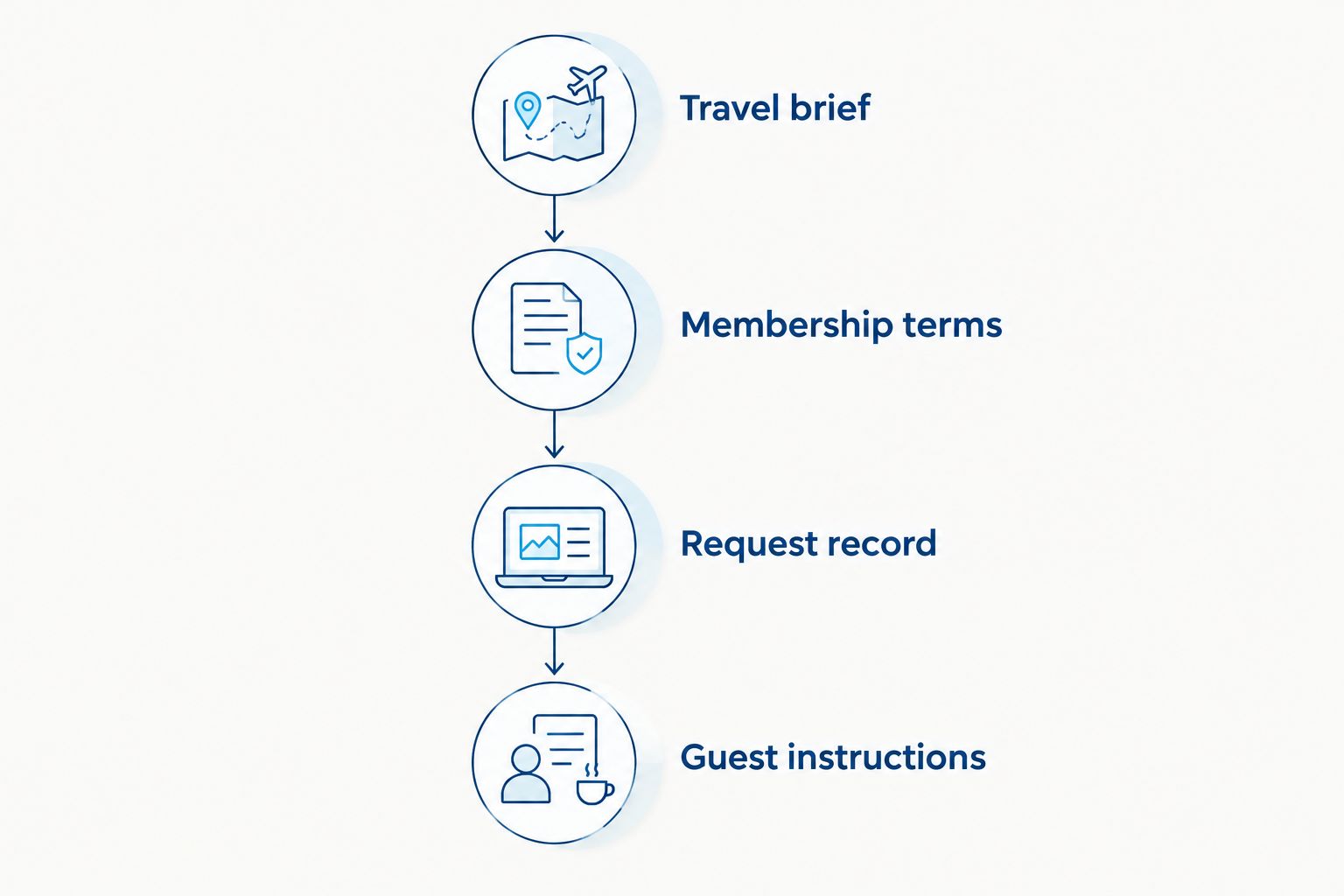
Use this sequence for every outing. Repeating the same process keeps the paperwork consistent while allowing the destination, group, and occasion to change.
When your destination or guest list changes
A second workflow applies when an existing plan changes. Update the underlying request before updating the people attending.
- Open the original request record and identify the change: region, date, group, or outing purpose.
- Check whether the change affects something already confirmed in writing.
- Submit the revised request through the agreed channel and ask which earlier arrangements it replaces.
- Keep the previous confirmation until the replacement is explicit. Then mark the earlier version Superseded in your document.
- Send guests the revised instructions only after the changes are confirmed.
Expected result: Everyone works from the same current arrangement, with a clear record of what changed.
A move between the Hamptons and Palm Beaches requires more than editing a destination name. Recheck membership coverage and departure arrangements for the revised region rather than carrying assumptions across.
For a 2026 calendar spanning both regions, maintain separate destination sections inside the same brief. You retain one planning system without implying that the underlying membership terms are identical.
Troubleshooting
The calendar says confirmed, but there is no written confirmation
Return the entry to Requested and ask for explicit confirmation through the agreed channel. Do not send guests definitive departure instructions based only on your own calendar status.
Keep the request history intact. Deleting the earlier messages makes it harder to identify which details still need agreement.
The membership discussion and agreement describe different things
Identify the exact point of disagreement and request written clarification before relying on it. Use the calendar entry affected by that issue to make the question concrete.
For example, ask whether the proposed agreement covers your intended region and outing type. Avoid accepting a broad reassurance in place of an answer to the actual request.
Your group changes after the outing is confirmed
Send the revised guest details before treating the change as accepted. Ask whether it affects the agreed vessel, boarding arrangements, or suitability for the outing.
Do not solve a guest-count change by assuming everyone can simply join. Keep invitations aligned with the confirmed arrangements.
A requested activity has not been agreed
Remove the activity from guest-facing plans until the operator confirms it. Swimming, dining, and other activities should be discussed as specific requests rather than inferred from the phrase yacht outing.
If the activity is essential to the occasion, say so before finalizing the plan. That is more useful than discovering a mismatch after invitations have gone out.
A weather concern affects the plan
Follow the operator's instructions and the applicable agreement terms. Ask what the concern means for your confirmed outing and what action you need to take.
Do not substitute a personal forecast interpretation for operational direction. Keep any revised arrangements in the same written record as the original confirmation.
Customize your workflow
Once the basic process works, adapt the brief to the way you host. Add an event contact for a celebration, a guest-requirements section for a family gathering, or a destination section for travel across both regions.
Keep those additions practical. A useful planning document tells someone what requires a decision; it does not need to become a detailed itinerary before the arrangements are agreed.
For recurring trips, copy the structure—not the confirmation. Reusing a guest checklist saves administrative effort, but each new outing still needs its own request and agreed details.
Discuss your yacht plans
Bring your travel brief and confirm which service fits your intended outings.
FAQ
Does FleetShare membership guarantee year-round yacht access?
Do not treat year-round yacht access as guaranteed unless your FleetShare agreement explicitly provides it. Match your intended regions and trips to the written membership terms before committing.
Can I use one FleetShare membership in the Hamptons and Palm Beaches?
Confirm cross-region access in the proposed membership agreement. Yachthampton serves the Hamptons and Palm Beaches, but that service footprint alone does not establish what one membership covers.
Is FleetShare membership better than booking an individual charter?
Review FleetShare membership for recurring plans and an individual charter for a specific outing. The right choice depends on your intended use and the terms offered, not the membership label alone.
How do I organize FleetShare membership yacht access for 2026?
Start with a travel brief, verify the membership terms, and keep a written record for each reservation request. Separate requested trips from confirmed outings before sending guest instructions.
Do I need a particular app to manage membership requests?
Use the reservation channel specified in your membership instructions. A personal calendar helps organize your plans but does not replace the operator's confirmation process.
What should I do when my yacht guest list changes?
Submit the revised guest details through the agreed contact channel and request confirmation of any affected arrangements. Update invitations only after the change is accepted.
Can I plan a celebration through my membership?
Confirm whether your proposed celebration fits the membership terms before treating it as covered. If it requires a separate charter, keep that inquiry distinct from your recurring leisure plans.
One last thing
A year-round yacht plan needs decision points, not just dates. Add a reminder beside each trip to review the guest brief, request status, and final instructions before you involve the wider group.
The most useful item in your planning document is the unresolved question. Give each one an owner and keep it visible until the written arrangements answer it.