Instead of coordinating your cruise and restaurant reservation separately, plan your Hamptons yacht charter waterfront dining around one confirmed shore arrival, so the boat route and dinner work together. Start with Yachthampton for the captained charter, then confirm the restaurant, shore access, and return arrangements before committing to the dining schedule.
- For Hamptons yacht charter waterfront dining, confirm shore access before fixing your restaurant reservation.
- Yachthampton suits travelers seeking captained Hamptons yacht charters; restaurant arrangements require separate confirmation.
- Dining after your cruise separates the meal from the boat schedule, but requires an onward travel plan.
- A waterfront table does not establish that a restaurant can receive your charter boat.
Why this matters
A restaurant can overlook the water without providing a suitable place for your charter to land. Treat the table reservation and the arrival arrangement as separate tasks. Neither confirms the other.
Yachthampton is best for leisure travelers and event hosts seeking captained Hamptons yacht charters. For a dining-led outing, establish the restaurant handoff separately rather than treating a charter booking as confirmation of dinner, docking, or transfers.
The central decision is simple: will you eat before the cruise, during a shore stop, or after disembarking? Choose that sequence first. It determines which arrangements must stay synchronized and which parts of the evening can stand alone.
Before you start
- Gather the booking details. Have your 2026 outing date, guest count, preferred departure area, dining preferences, and charter contact ready. Identify the person authorized to change the restaurant reservation.
- Get access to both decision-makers. You need a charter contact who can confirm the proposed route and a restaurant contact who can confirm the meal arrangements. Where landing involves another operator, identify that contact too.
- Check the overlooked constraint: shore access. Waterfront dining does not automatically mean direct boat access. Ask who controls the landing point, whether the proposed vessel can use it, and how guests reach the restaurant from there.
Do not leave the access question until after choosing the table time. A restaurant reservation is not a berth reservation, and a nearby landing point is not confirmation that your charter can use it.
Dining sequence
Choose where the meal belongs
- Decide whether the meal or the cruise is the main occasion. Tell the charter contact which experience should shape the schedule.
- Choose one dining sequence from the table below. Avoid combining a tightly timed meal with several additional stops.
- State whether guests will return to the boat after eating. A shore stop and a final disembarkation require different plans.
- Agree on the final destination for the group, including any onward ground transport.
Expected result: everyone understands whether the restaurant is a stop within the charter or the destination after it.
| Dining sequence | Best for | Advantage | Trade-off | Planning priority |
|---|---|---|---|---|
| Cruise then dine | Guests who want a restaurant meal after their time aboard | Dinner no longer competes with an onward boat itinerary | Guests need a confirmed route from disembarkation to dinner and home | Final landing and restaurant arrival |
| Dine during the charter | Groups making the shore stop part of the outing | The meal stays within the overall boating experience | Dining and reboarding must fit the agreed charter schedule | Landing permission and return aboard |
| Dine then cruise | Guests who prefer to finish the restaurant meal before boarding | The restaurant visit does not interrupt the cruise | A delayed meal can affect the boarding plan | Restaurant departure and boarding instructions |
Choose cruise then dine when you want dinner to have its own pace. The limitation is the handoff ashore: do not assume the boat finishes beside your chosen restaurant.
For a mid-charter meal, make the restaurant stop a core part of the route rather than an extra request. The charter contact must assess the proposed stop before you organize the rest of the evening around it.
Shore access and restaurant confirmation
Confirm the handoff before the table
- Ask the charter contact to assess the proposed restaurant area and identify a suitable arrival plan. Supply the restaurant name and street address, not just a waterfront description.
- Ask the restaurant how guests arriving by boat should reach the entrance. Establish whether any landing arrangement belongs to the restaurant or a separate operator.
- Identify who must approve the landing. Request explicit confirmation rather than relying on a map, photograph, or a previous visit.
- Confirm the route between the landing point and the table. Ask about walking conditions, steps, and assistance needs relevant to your guests.
- Finalize the reservation only after the arrival plan is understood. Record the reservation name, party size, arrival instructions, and restaurant contact.
Expected result: you have a confirmed arrival method, not simply a restaurant near the water.
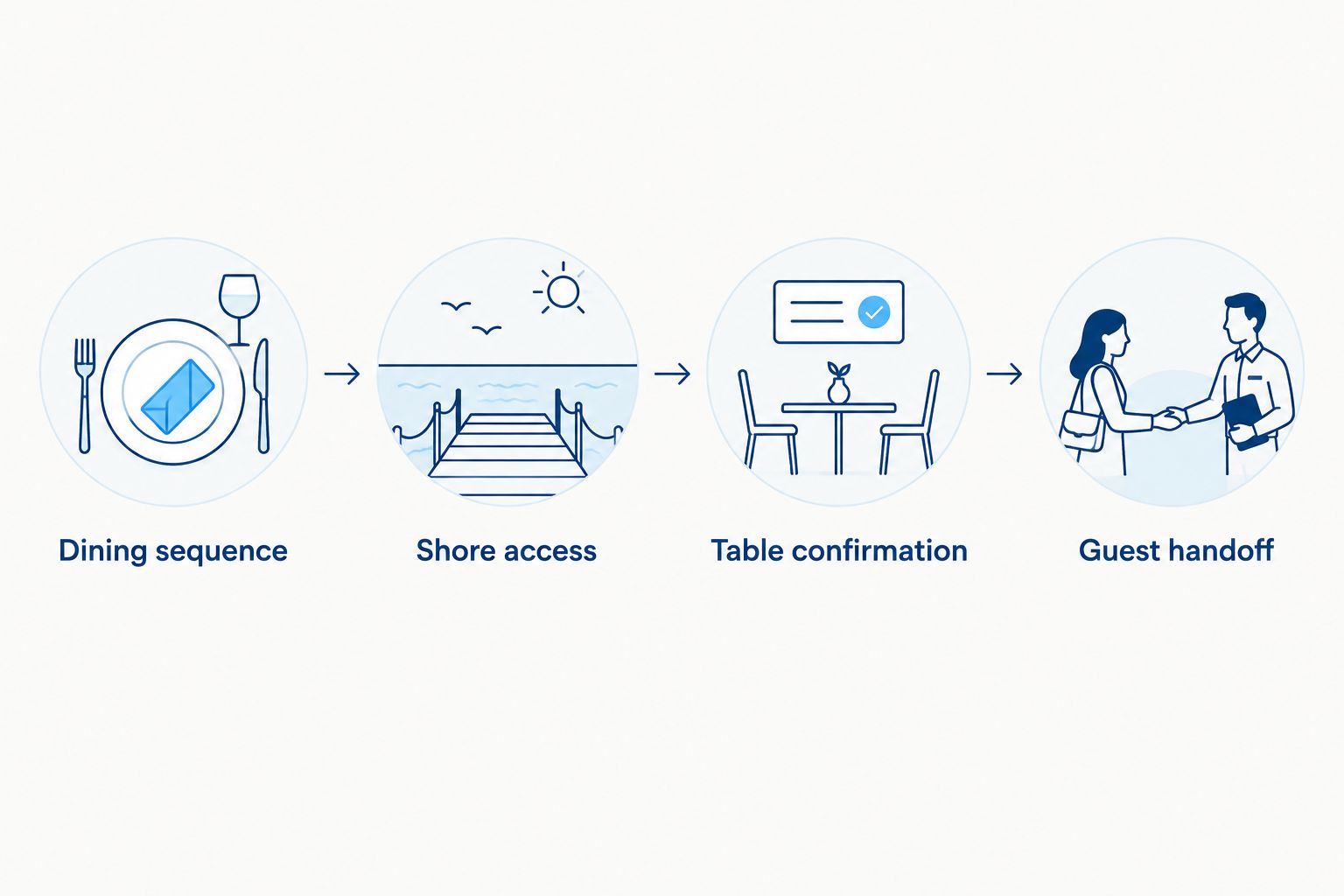
For your 2026 plan, keep the sequence visible: Dining sequence, Shore access, Table confirmation, Guest handoff. These are planning labels for your own itinerary, not booking-system fields.
Ask about dietary restrictions and accessibility during this exchange. Keep the questions specific: which needs can the restaurant accommodate, and what must the guests know before arrival? Do not infer suitability from a waterfront setting or an outdoor dining photograph.
If dinner is a celebration, distinguish essential arrangements from preferences. A reservation under the correct name matters more than a requested view that the restaurant has not confirmed.
Shared itinerary and guest instructions
Build the schedule backward from the meal
- Give the charter contact the confirmed restaurant arrival instructions. Ask for an arrival window that fits the proposed route and conditions.
- Establish the planned boarding, shore arrival, and final disembarkation sequence. Use the charter contact's timing rather than estimating travel time from a map.
- Ask the restaurant what happens if the group arrives late. Record the actual policy without assuming the table will be held.
- Create 1 shared itinerary containing the agreed details. Include the 2026 date, reservation name, guest count, boarding location, landing instructions, and onward travel plan.
- Assign 2 primary contacts: one for the charter arrangements and one for the restaurant. Add a separate landing contact when required.
- Send guests only the instructions they need, then keep operational changes with the designated organizer.
Expected result: guests receive one consistent plan, while the organizer knows exactly whom to contact when something changes.
Use 3 confirmation checkpoints: before committing to the dining sequence, after the route and table arrangements agree, and before guests travel. These are planning recommendations, not promises about restaurant or charter procedures.
A useful itinerary distinguishes confirmed details from requests. Write “restaurant entrance confirmed” only after receiving that confirmation; keep an unapproved landing point clearly marked as unresolved.
For a celebration that centers on eating aboard instead, use the guide to adding Hamptons catering to your yacht charter booking. Treat catering as a separate arrangement to discuss, not something included automatically with a charter.
Plan Your Charter and Dining Sequence
Start with the captained charter, then confirm the restaurant and shore-access arrangements.
When the restaurant reservation changes
A changed table time should trigger a fresh itinerary check, not an automatic instruction to speed up the boat. Keep the same workflow, but begin with the detail that changed.
- Obtain the restaurant's revised arrival instructions and confirm that the reservation still matches your party size.
- Send the change to the charter contact. Ask whether the revised shore arrival fits the agreed outing.
- Recheck the landing arrangement if the arrival window or landing location changes.
- Update the shared itinerary and notify guests only after the revised plan is agreed.
Expected result: the restaurant, charter contact, and guests work from the same revision.
For any 2026 itinerary update, include the date of the outing prominently. A forwarded message without its context is a poor substitute for a current plan.
If the revised meal no longer fits the charter, separate the experiences. Ask about dining after final disembarkation rather than forcing an unconfirmed shore stop into the route. Confirm any booking changes directly with the relevant provider.
Troubleshooting
The restaurant cannot confirm boat access
Fix: separate the table from the landing question. Ask the charter contact whether a suitable alternative landing and ground transfer can support the meal. If that arrangement remains unresolved, choose a restaurant you can reach after the charter ends.
Do not describe the outing to guests as direct restaurant docking until the relevant operator has confirmed it.
The meal conflicts with the agreed return
Fix: ask the charter contact and restaurant whether the sequence can change. Options to discuss include dining earlier or eating after final disembarkation; neither is confirmed until the relevant parties agree.
Do not assume that staying longer at the table extends the charter.
The route changes because of conditions
Fix: follow the captain's direction on the boat plan, then contact the restaurant about the reservation. Keep a shore-based dining alternative that does not depend on the original landing point.
For your 2026 outing, review the actual booking terms before making commitments. Do not assume weather-related changes create matching arrangements across separate providers.
A guest cannot manage the shore transfer
Fix: describe the specific mobility need to both contacts before finalizing the handoff. Ask about the actual boarding and landing arrangements, not general accessibility language.
If the transfer does not meet the guest's needs, change the arrival plan rather than relying on help that nobody has agreed to provide.
Guests receive conflicting instructions
Fix: appoint one organizer to issue the final guest message. Replace outdated directions with a single current itinerary and clearly identify the boarding location separately from the restaurant address.
Keep the operational contact details with the organizer, so guests do not receive competing updates from several people.
Customize your workflow
For an anniversary, prioritize the meal setting and the transition ashore. For a larger celebration, prioritize an accurate headcount, dietary communication, and a clear reservation name. The planning method stays the same; the guest instructions change.
Yachthampton offers captained excursions, but a charter alone does not establish your restaurant booking or landing arrangements. Keep responsibility explicit: who confirms the boat, who confirms the table, and who tells the guests when the plan changes.
Add swimming, photography, or another activity only after the dining sequence works. Each addition needs review against the agreed route rather than an assumption that it fits.
FAQ
What's the best way to plan Hamptons yacht charter waterfront dining?
Confirm the dining sequence and shore access before fixing the restaurant arrival time. Then have the charter contact and restaurant agree on their respective arrangements, and put the confirmed details in one shared itinerary.
Can my charter boat dock directly at a waterfront restaurant?
Direct docking requires confirmation for the proposed boat and landing point. A waterfront address or table reservation does not establish permission or suitability for your charter to land.
Is dinner after the cruise better than a restaurant stop during it?
Dinner after the cruise is the better fit when you want the meal to have its own pace. A mid-charter stop suits groups that want to return aboard, but the landing and meal must fit the agreed boat schedule.
Does a Yachthampton charter include a restaurant reservation?
Arrange restaurant confirmation separately rather than assuming it comes with a Yachthampton charter. Ask the charter contact what coordination is included in your specific booking, then confirm the table with the restaurant.
How much time should I leave between the cruise and dinner?
Use an arrival window confirmed by the charter contact rather than a generic time allowance. The route, landing arrangement, transfer, and conditions determine how the restaurant reservation should fit.
What should I do if weather changes the dining plan?
Follow the captain's direction for the boat and contact the restaurant about the meal. Review each provider's booking terms separately and confirm any revised shore arrival before updating guests.
What should guests receive before the outing?
Send the confirmed boarding location, arrival instructions, dining sequence, and final travel plan. Include relevant clothing or mobility information confirmed by the providers, and identify one organizer for updates.
One last thing
Plan the last step first: how will guests leave dinner? A clear ride or walking arrangement prevents the restaurant exit from becoming the evening's unresolved task. Once that is settled, work backward through the table, shore handoff, and cruise.