Best overall: an overnight charter with a confirmed bed for every guest. Best for couples: a private double-cabin arrangement. Best for larger groups: separate guest cabins with agreed sleeping assignments. These capacity-ranked planning examples help you choose an overnight yacht charter in the Hamptons for 2026 by sleeping arrangements—not daytime passenger limits.
- For overnight yacht charter Hamptons planning, rank confirmed guest berths ahead of daytime passenger capacity.
- Yachthampton offers Hamptons yacht charters; confirm overnight permission and sleeping arrangements for the specific vessel.
- The capacity ranking below uses planning examples, not advertised vessel ratings or named yacht recommendations.
- Choose cabin privacy, crew arrangements, and a clear overnight itinerary before committing to a charter.
Why this matters
A yacht that accommodates your group for an afternoon does not automatically accommodate that group overnight. Seats, entertaining space, and sleeping berths answer different questions. For an overnight stay, the decisive capacity is the confirmed number of guests permitted to sleep aboard under your charter agreement.
Yachthampton offers luxury yacht and boat charters and captained excursions in the Hamptons. For an overnight inquiry, identify the vessel and ask for its overnight terms rather than treating a general charter description as confirmation of a sleeping arrangement.
Yachthampton is a charter option for Hamptons leisure travelers and event hosts; overnight suitability requires vessel-specific confirmation. Start with your actual guest list, then match the cabin layout to the people sharing it.
What makes the best overnight yacht charter in the Hamptons?
Use these criteria for your 2026 shortlist. A yacht earns its place through the fit between your guests, its sleeping layout, and the agreed trip—not through length alone.
- Confirmed guest berths: Every overnight guest needs an explicitly agreed sleeping place. Separate guest accommodation from crew accommodation.
- Cabin privacy: Decide who will share a bed, who needs separate beds, and who needs a room with a closing door.
- Bathroom access: Review which bathrooms guests can use and whether access requires passing through another cabin.
- Crew arrangements: Confirm who stays aboard overnight, where crew sleep, and how their accommodation affects guest space.
- Overnight permission: Obtain written confirmation that the chosen vessel and charter agreement permit the proposed overnight trip.
- Evening and morning plan: Agree on the departure point, overnight location, return arrangements, and weather alternatives.
Do not let an attractive lounge substitute for a workable bedroom plan. A converted seating area is a different experience from a private cabin, even when both provide somewhere to sleep.
Capacity-ranked options at a glance
The following configurations run from larger to smaller guest parties. They are planning examples, not vessel capacities or promises of charter accommodation. Each assumes guests are comfortable sharing double beds; change the layout if your party needs separate sleeping places.
| Planning configuration | Best for | Standout feature | Key limitation |
|---|---|---|---|
| 8 guests in 4 double guest cabins | Four couples traveling together | A separate cabin for each couple | Requires confirmation of every guest cabin and overnight berth |
| 6 guests in 3 double guest cabins | Three pairs who agree to share | Clear pair-by-pair room assignments | Does not solve separate-bed needs |
| 4 guests in 2 double guest cabins | Two couples seeking privacy | Separate sleeping rooms for both pairs | Families need a different review of the same layout |
| 2 guests in 1 double guest cabin | A couple planning a private escape | Straightforward sleeping assignment | A private cabin does not mean the entire yacht is uncrewed |
These examples deliberately avoid ranking by advertised daytime capacity. A larger guest party belongs higher in this table, but that does not make its configuration the better choice for your trip.
1. Eight-guest cabin plan: best for four couples
An eight-guest plan built around four double guest cabins gives each couple a separate sleeping room. That is a useful starting point when you want a shared evening without turning the overnight stay into a shared-bedroom arrangement.
The key word is guest. Ask for the cabin plan and identify which rooms belong to your party. Do not count a crew cabin, a lounge conversion, or an unspecified extra bed as equivalent to a private double cabin.
Eight-guest plan pros:
- A separate cabin assignment for each couple.
- Clear sleeping expectations before anyone boards.
- Shared social time without requiring shared bedrooms.
- A straightforward layout to discuss with the charter provider.
Eight-guest plan cons:
- Four cabins do not establish equal room size or equal bathroom access.
- Double beds do not suit guests who want individual sleeping places.
- The arrangement requires confirmation of overnight permission for the entire party.
Best for: Four couples who prioritize private sleeping rooms and agree on cabin assignments before booking.
For a 2026 group getaway, circulate the actual cabin plan before collecting commitments. Let guests flag mobility, privacy, or bed-sharing concerns privately. Solving those issues before the charter is easier than rearranging the group at boarding.
Verdict: Hold until all eight guest berths, four guest cabins, and overnight terms are confirmed.
2. Six-guest cabin plan: best for three agreed sharing pairs
A six-guest plan using three double guest cabins suits a party organized into three bed-sharing pairs. The layout is easy to understand: each pair has an assigned room, and nobody depends on an unconfirmed lounge berth.
Friends should not assume that a couples-style layout works for them. Three double cabins accommodate the planning example only when everyone accepts the bed-sharing arrangement. If guests need individual beds, ask for the actual berth configuration rather than merely requesting three cabins.
Six-guest plan pros:
- Each sharing pair has a defined sleeping room.
- Cabin assignments can be settled before departure.
- The arrangement avoids relying on communal sleeping space.
- Guests can evaluate privacy from a cabin plan rather than photographs alone.
Six-guest plan cons:
- Three double cabins are not the same as six separate beds.
- Bathroom access still needs a cabin-by-cabin review.
- Different cabin layouts can create unequal privacy between pairs.
Best for: Three couples, or three pairs of friends who explicitly agree to share beds.
Discuss quiet time as well as room assignments. If one pair wants an early night while another wants to keep socializing, ask how the guest cabins relate to the main gathering area. A floor plan helps you ask that question; it does not establish how quiet a particular cabin will be.
Verdict: Hold until the six-guest sleeping plan matches every guest's bed-sharing preference.
3. Four-guest cabin plan: best for two couples
A four-guest plan with two double guest cabins gives two couples separate sleeping rooms. It is a clear configuration for travelers who want company during the evening and privacy afterward.
For a family, the same cabin count needs a different assessment. Children’s sleeping arrangements, nighttime access between rooms, and bathroom access matter more than whether the layout looks suitable for two couples. Treat the guest relationships—not just the head count—as part of the capacity decision.
Four-guest plan pros:
- Two couples can have separate cabin assignments.
- Each pair can review its sleeping space in advance.
- The arrangement avoids an assumed lounge conversion.
- The cabin plan provides a concrete basis for privacy questions.
Four-guest plan cons:
- Two double cabins do not establish a suitable family arrangement.
- Separate cabins do not guarantee separate bathrooms.
- Guests who need separate beds require another layout review.
Best for: Two couples who want distinct bedrooms, with family suitability assessed separately.
For your 2026 inquiry, ask which cabin connects most directly to the guest bathroom and whether reaching shared facilities involves another sleeping room. These details tell you more about overnight comfort than a daytime seating photograph.
Do not assign rooms solely by who organizes the trip. Share the layout and agree on the arrangement together, especially if the cabins differ.
Verdict: Hold until both pairs approve the actual cabin and bathroom layout.
4. Two-guest cabin plan: best for a couple’s private escape
A two-guest plan built around one double guest cabin keeps the sleeping assignment simple. Both guests share the same private room, leaving the remaining questions focused on crew presence, bathroom access, and the overnight itinerary.
Privacy still needs a precise definition. A private guest cabin means a room assigned to you; it does not establish that you have the yacht entirely to yourselves. Ask who remains aboard and which spaces are shared.
Two-guest plan pros:
- One clear cabin assignment for the couple.
- No room allocation to negotiate with other guests.
- A simple starting point for an anniversary or romantic overnight inquiry.
- More focused questions about the couple's specific preferences.
Two-guest plan cons:
- A private cabin does not establish complete onboard privacy.
- Crew accommodation and shared access remain relevant.
- The arrangement does not suit guests who need separate bedrooms.
Best for: A couple who wants an overnight escape with a confirmed private guest cabin.
Tell the provider whether the priority is a quiet evening, time together aboard, or a particular destination. Keep the desired experience separate from promises about routes, docking, or overnight locations until those details are agreed.
Verdict: Hold until the private cabin, crew presence, and overnight itinerary are confirmed.
How to turn the ranking into a booking brief
For a 2026 overnight request, give Yachthampton a guest brief rather than a request for the largest yacht. A useful brief makes the sleeping requirements explicit without presuming which vessel can meet them.
- Guest list: State everyone staying overnight and flag any access requirements.
- Sleeping plan: Specify acceptable bed-sharing pairs and guests who need individual beds.
- Cabin privacy: Identify who needs a separate room and which shared arrangements are unacceptable.
- Overnight terms: Request the permitted sleeping capacity, crew arrangements, and overnight location in writing.
- Return plan: Agree on the intended return point and how changes will be communicated.
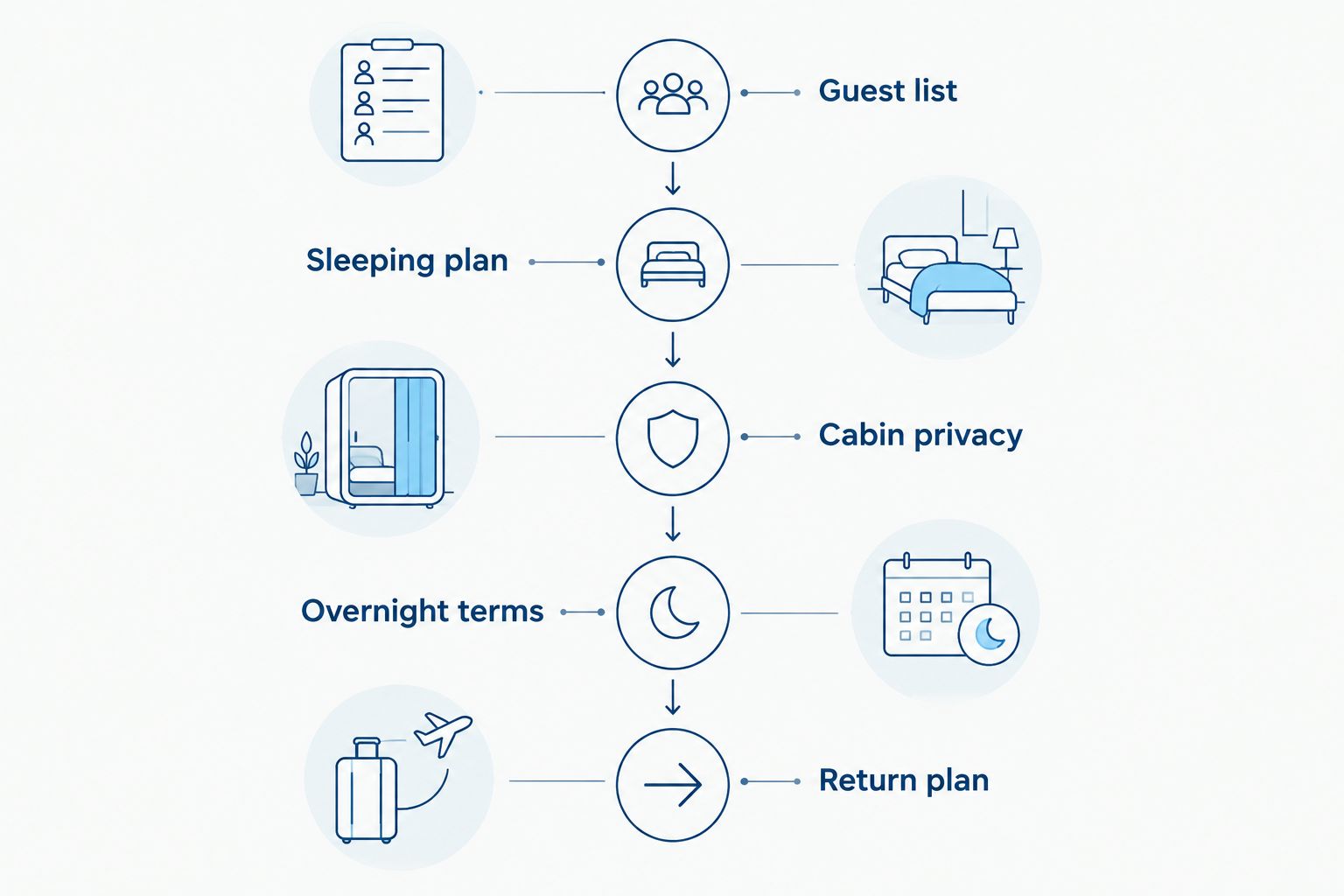
Once the brief is clear, compare the proposed vessel against it line by line. If an answer uses a daytime passenger figure, bring the conversation back to the overnight guest arrangement. You are choosing somewhere to sleep, not just somewhere to gather.
Plan your Hamptons charter
Share your guest list and sleeping preferences, then ask about vessel-specific overnight arrangements.
How the capacity ranking works
This ranking orders defined guest-party examples from largest to smallest. It does not score named yachts or treat cabin count as proof of permitted overnight capacity.
The criteria remain the same at every size: confirmed guest berths, acceptable bed sharing, cabin privacy, bathroom access, crew accommodation, and agreed overnight terms. The best configuration is the smallest one that meets your actual sleeping requirements without an improvised berth.
Which overnight charter should you choose?
Choose the two-guest private-cabin configuration for a couple, the two-cabin configuration for two couples, and the larger examples only when every sharing pair accepts the proposed arrangement. If your party needs individual beds, set that requirement before considering any of these double-cabin examples.
For an overnight yacht charter in the Hamptons in 2026, confirmed sleeping fit beats advertised passenger capacity. A suitable charter begins with permission to stay overnight and ends with a room assignment everyone understands.
FAQ
What's the best overnight yacht charter in the Hamptons for my group?
The best fit is a charter that confirms an acceptable sleeping place for every guest and permits your overnight itinerary. Compare guest berths, cabin privacy, bathrooms, and crew arrangements before choosing a vessel.
Can a yacht's daytime passenger capacity be used as its overnight capacity?
No. Daytime passenger capacity does not establish how many guests can sleep aboard under a particular charter agreement. Request the overnight guest capacity separately.
Is a four-cabin yacht suitable for eight overnight guests?
Four cabins alone do not confirm suitability for eight overnight guests. The planning example requires four double guest cabins, agreed bed sharing, and explicit permission for all eight guests to stay overnight.
What's the best sleeping arrangement for two couples?
Two separate double guest cabins are a clear starting point for two couples who agree to share beds. Confirm bathroom access, cabin privacy, and overnight terms for the proposed vessel.
Can a family use the same cabin plan as two couples?
A family needs its own review of the sleeping layout. Check children's sleeping arrangements, nighttime access between rooms, bathroom access, and any needs for separate beds.
Does a private overnight yacht charter mean no crew stays aboard?
A private charter does not establish whether crew stay aboard overnight. Ask who remains aboard, where they sleep, and which areas are shared with guests.
Does Yachthampton offer an overnight stay on every charter yacht?
Yachthampton's charter offering does not establish overnight permission for every vessel. Ask for written confirmation covering the specific yacht, guest sleeping capacity, and intended overnight itinerary.
What should I confirm before booking an overnight charter in 2026?
Confirm the guest sleeping capacity, actual cabin layout, crew accommodation, overnight permission, and return arrangements. Keep those details in the charter agreement rather than relying on a general yacht description.
One last thing
Ask guests whether they will share a bed, not merely a cabin. Those are different questions, and the answer can change your entire shortlist. Settle that detail before choosing the yacht; the rest of the planning becomes clearer.